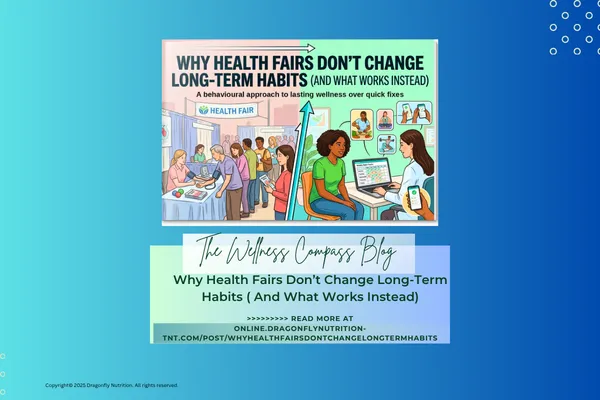
Why Health Fairs Don't Change Long-Term Habits (And What Works Instead)
Every year, thousands of workplaces and communities host health fairs. Attendees walk from booth to booth, grab a branded stress ball, sample a protein bar, and get their blood pressure, glucose, or BMI checked.
By all standard engagement metrics, the event looks like a success: attendance is tracked, flyers are distributed, and awareness is raised.
Yet six months later, health outcomes and daily routines remain largely unchanged. Why does a well-intentioned, highly visible event consistently fail to move the needle on chronic health markers and daily habits?
The disconnect comes down to how human behavioural biology and habit architecture actually work.
The Flaws in the Health Fair Model
Health fairs operate under a traditional health education assumption: if people know their numbers, they will change their actions. Behavioural science has repeatedly shown that information alone rarely drives sustained change.
Biometrics Without a Pathway: Discovering elevated fasting blood glucose or high blood pressure creates immediate health anxiety, but rarely provides a structured, personalized path forward. Without actionable scaffolding, that anxiety typically fades into avoidance.
The "One-and-Done" Illusion: Habits are neurological loops built through repetition, cues, and feedback over months, not single-day events. A single afternoon of screenings provides zero continuous reinforcement.
Passive Consumption vs. Active Implementation: Taking a brochure on "Eating More Fibre" requires no cognitive commitment. Reading about nutrition does not resolve the friction of planning, grocery shopping, cooking, or managing cravings during a stressful workday.
Lack of Environmental Restructuring: Health fairs address the individual in isolation while ignoring the day-to-day environment, such as workplace culture, pantry stocking, sleep schedules, and chronic time scarcity that dictates everyday choices.
Why Habit Change Requires More Than Awareness
According to behavioural frameworks like B.J. Fogg’s Behaviour Model (B = MAP: Behaviour happens when Motivation, Ability, and a Prompt converge) and the Transtheoretical Model of Change:
Motivation is Volatile: A health fair creates an artificial spike in motivation that rapidly drops within 48 to 72 hours. Sustainable habits must rely on low-friction systems rather than high willpower.
Actionable Ability is Often Missing: Telling someone to "exercise 150 minutes a week" or "reduce ultra-processed foods" sets a broad target without teaching the micro-skills necessary to execute it when tired, busy, or stressed.
Feedback Loops Must Be Iterative: When individuals try to change their lifestyle, they encounter obstacles such as travel, emotional eating, social events, and injury. Without regular touchpoints to troubleshoot setbacks, initial attempts usually stall.
What Actually Works: 4 Evidence-Based Alternatives
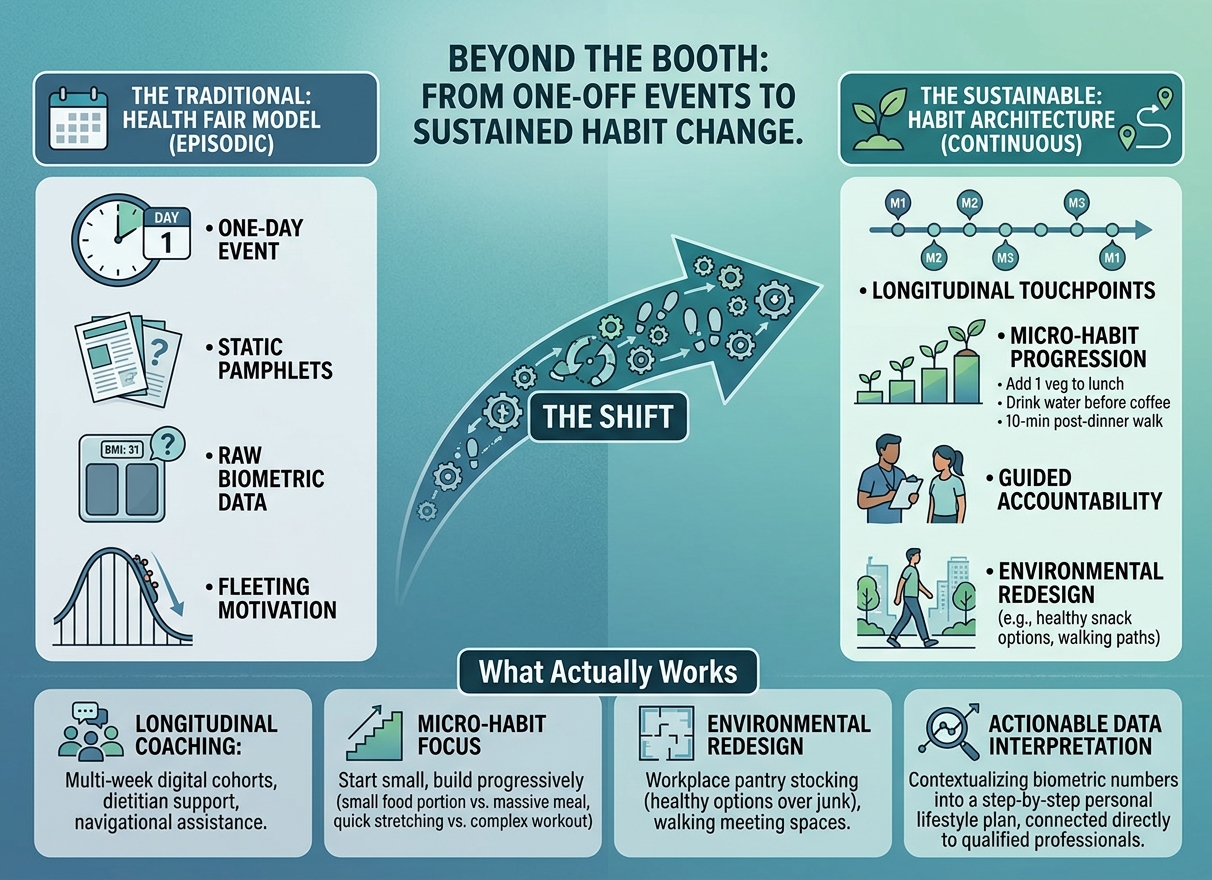
To produce measurable, durable improvements in health, interventions must transition from episodic events to continuous, structural systems.
1. Longitudinal Coaching and Structured Programs
Instead of a single screening day, effective programs provide multi-week or multi-month frameworks. Ongoing accountability, whether through registered dietitians or structured digital cohorts, allows individuals to make progressive adjustments, receive feedback, and navigate real-world barriers.
2. Focus on Micro-Habits Over Major Overhauls
Long-term adherence increases when targets start small and build progressively:
Instead of: "Completely overhaul your diet starting Monday."
Focus on: Adding 1 serving of vegetables to lunch, drinking a glass of water before morning coffee, or establishing a consistent 10-minute post-dinner walk.
3. Environmental and Cultural Redesign
Environmental cues heavily influence behaviours. In workplace or household settings, lasting change happens when you alter defaults:
Stocking whole-food snacks instead of refined sugars in common areas.
Encouraging walking meetings and realistic boundary-setting around off-hours communication to protect sleep.
Providing access to comprehensive wellness programs rather than one-off wellness swag.
4. Actionable, Guided Interpretation of Health Markers
Data is only useful when paired with ongoing context; rather than handing someone an elevated biometric reading at a booth, high-impact strategies connect individuals directly with qualified professionals who can contextualize the numbers and build a tailored, step-by-step nutrition and lifestyle plan.
Moving Beyond the Booth
Health fairs are not entirely useless, they can serve as an entry point for basic screening and triage. However, treating them as a standalone wellness solution confuses awareness with execution.
If the goal is genuine, lifelong health improvement, the focus must shift away from annual spectacles and toward consistent accountability, supportive environments, and gradual habit design.


